
Alarm prediction
Overview
Buffers 50 numeric data points and predicts the number of data points until the alarm value is likely to be exceeded
For example, it is hoped that alarms can be predicted based on measured values, takt time or the operating time of cylinders and the like
Values exceeding the alarm value are not kept in the buffer and are ignored
The graph below shows the offset and slope of the execution result
The FB outputs the position where the line exceeds the upper or lower limit
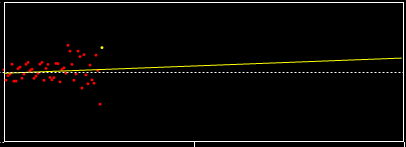
Prediction method
A regression line is obtained from the last 50 data points.
\[
y=ax + b
\]
a: slope
b: intercept
The position where this line crosses the alarm value is calculated to predict how many more cycles until the alarm value is exceeded.
What Is Predictive Maintenance?
Predictive maintenance is the idea of detecting signs of anomalies before equipment fails and performing planned maintenance.
It is used to reduce equipment downtime and optimize maintenance costs.
Use cases
- Takt time monitoring
- Cylinder operation time monitoring
- Motor startup time monitoring
- Temperature rise monitoring
- Pressure change monitoring
Symbols
PredictCount
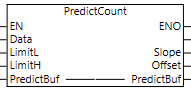
- Data
- Input data
- LimitL
- Lower limit
- LimitH
- Upper limit
- Out
- Predicted cycles until alarm value exceeded
- Slope
- Slope
- Offset
- Offset
- PredictBuf
- Buffer
How to Use
Buffer
The buffer is an LREAL array whose number of elements can be changed (the sample uses a buffer of 50)
This buffer keeps recent data for internal calculations, so do not change it externally
How to measure
Enter the upper and lower limits in advance
Enter input data and turn EN ON to output the predicted cycles until the alarm value is exceeded (Out)
If the input data exceeds the upper or lower limit, ENO stays False and the predicted cycles (Out) is zero
