
What Is a PLC?
The PLC (Programmable Logic Controller) was born in 1968 in response to a request from the American automaker General Motors (GM). It dramatically solved the problems of relay control, the mainstream method at the time: rewiring was tedious and costly. The PLC replaced that wiring with software, using computer technology to make control logic programmable.
Background and History of the PLC
PLC Release Timeline (Major Japanese PLC Manufacturers)
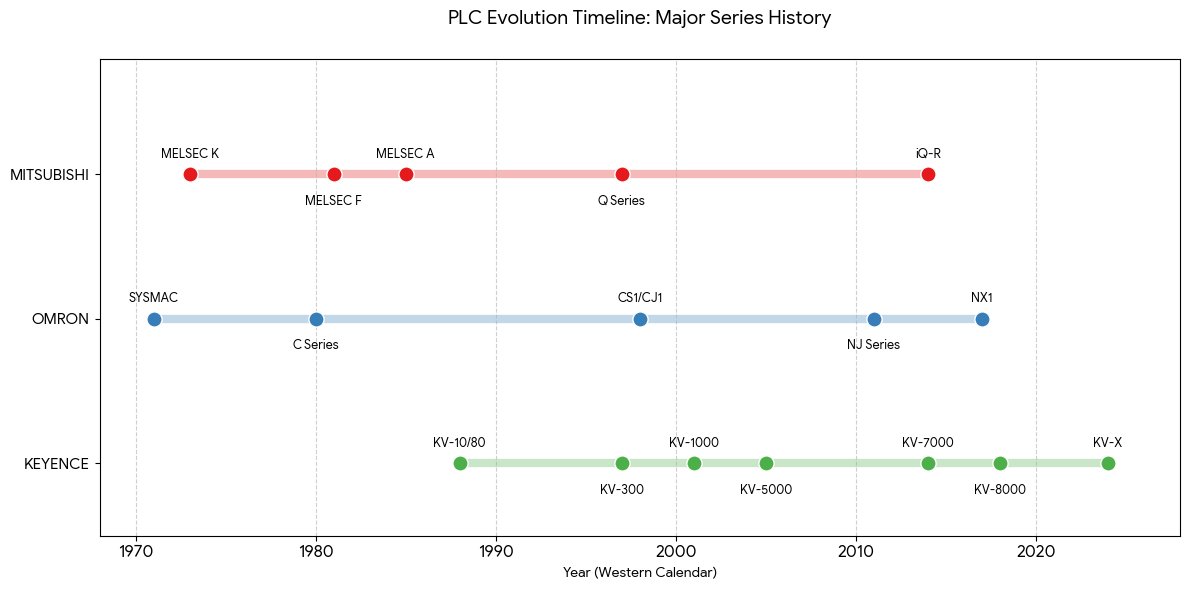
From Relay Control to Software Control
Before the PLC appeared, machines were controlled by electrical wiring known as relay circuits. Relay circuits involved complicated wiring that was difficult to change. They also failed frequently and were hard to maintain.
To solve these problems, GM published a specification in 1968 for "a device that can switch logic without rewiring." In response, Modicon (now part of Schneider Electric), founded by Dick Morley and others, developed the world's first commercial PLC, the Modicon 084, in 1969.
Ladder diagrams took the place of relay circuits, so engineers could build logic intuitively on screen in a notation that mirrors relay wiring in a simple form.
In Japan, OMRON brought a PLC to market in 1972 under the name "SYSMAC." It was the first commercial PLC in Japan and had a major impact on Japanese industry. Mitsubishi Electric and other companies followed, and the PLC market grew substantially.
The 1990s
PLCs became the mainstream controller in FA (Factory Automation).
Thanks to their low cost, high performance and easy maintenance, PLCs became the standard in FA, and integration with servos, inverters and touch panels advanced.
The 2000s
As Ethernet spread, PLCs became networked. Connections were needed not only between PLCs but also to PCs, SCADA and MES.
The 2010s
Improved PLC performance made complex control possible. With IoT, Industry 4.0 and smart factories as keywords, support for OPC UA, databases and the cloud moved forward.
PLC Characteristics by Manufacturer
Mitsubishi Electric
Used in a wide range of industries, including automotive, food, semiconductors and infrastructure.
Main Series
iQ-R series : High-end models
iQ-F series : For small to mid-sized systems
Q series, A series : Still running in older equipment
Modules
A wide variety is available, including analog, motion, serial, CC-Link, EtherNet/IP, Modbus, high-speed counter and temperature control modules.
Characteristics
Works very well with servos
Large lineup gives plenty of choice, but can be confusing
Abundant learning materials and strong training support
Spare parts are easy to obtain
Communication setup is somewhat cumbersome
OMRON
Used in a wide range of industries, including automotive, food, semiconductors and infrastructure.
Main Series
NX/NJ series : High-end models
CS/CJ series : Previous generation
Modules
A wide variety is available, including analog, motion, serial, EtherCAT, EtherNet/IP, Modbus, high-speed counter and temperature control modules.
Characteristics
Works very well with servos connected via EtherCAT, and excels at synchronized control
Strong EtherCAT connectivity makes it easy to integrate European equipment
The NX/NJ series and the CJ/CS series use different development environments
The NX/NJ series is programmed according to IEC 61131-3, so there is a learning curve
Works very well with sensors
KEYENCE
Used in a wide range of industries, including automotive, food, semiconductors and infrastructure.
Main Series
KV-X series : High-end models (IEC 61131-3 compliant)
KV-8000 series : High-end models
Modules
A wide variety is available, including analog, motion, serial, EtherCAT, CC-Link IE, EtherNet/IP, high-speed counter and temperature control modules.
Characteristics
Fast processing speed
Strong at data collection
Strong networking capabilities
Works very well with sensors such as vision systems and laser displacement sensors
Simple, easy-to-understand development environment UI
Excellent support
PLC Comparison by Manufacturer
| Item | Mitsubishi | OMRON | KEYENCE |
|---|---|---|---|
| Legacy equipment support | ◎ | ◎ | △ |
| Motion control | ○ | ◎ | ○ |
| EtherCAT | △ | ◎ | ○ |
| CC-Link | ◎ | △ | ○ |
| High-speed processing | ○ | ○ | ◎ |
| Communication flexibility | ○ | ◎ | ◎ |
| Sensor integration | ○ | ◎ | ◎ |
| Spare parts availability | ◎ | ○ | ○ |
| Learning resources | ◎ | ○ | △ |
Future Trends
As networking continues to advance,
- EtherNet/IP
- EtherCAT
- OPC UA
- MQTT
- DataBase
- Python integration
- Use of AI
are becoming increasingly important technologies.
Summary
Each PLC manufacturer has its own strengths. When choosing a PLC, understand those characteristics and take future trends into account.
Mitsubishi : Strong legacy equipment support and strong motion control.
OMRON : Works very well with EtherCAT-connected servos and excels at synchronized control.
KEYENCE : Strong at high-speed processing, networking and sensor integration.